Incomlend Capital Launches Variable Capital Company (VCC)
Incomlend Capital launches its Singapore-regulated Variable Capital Company (VCC), offering institutional investors a flexible and transparent investment structure.

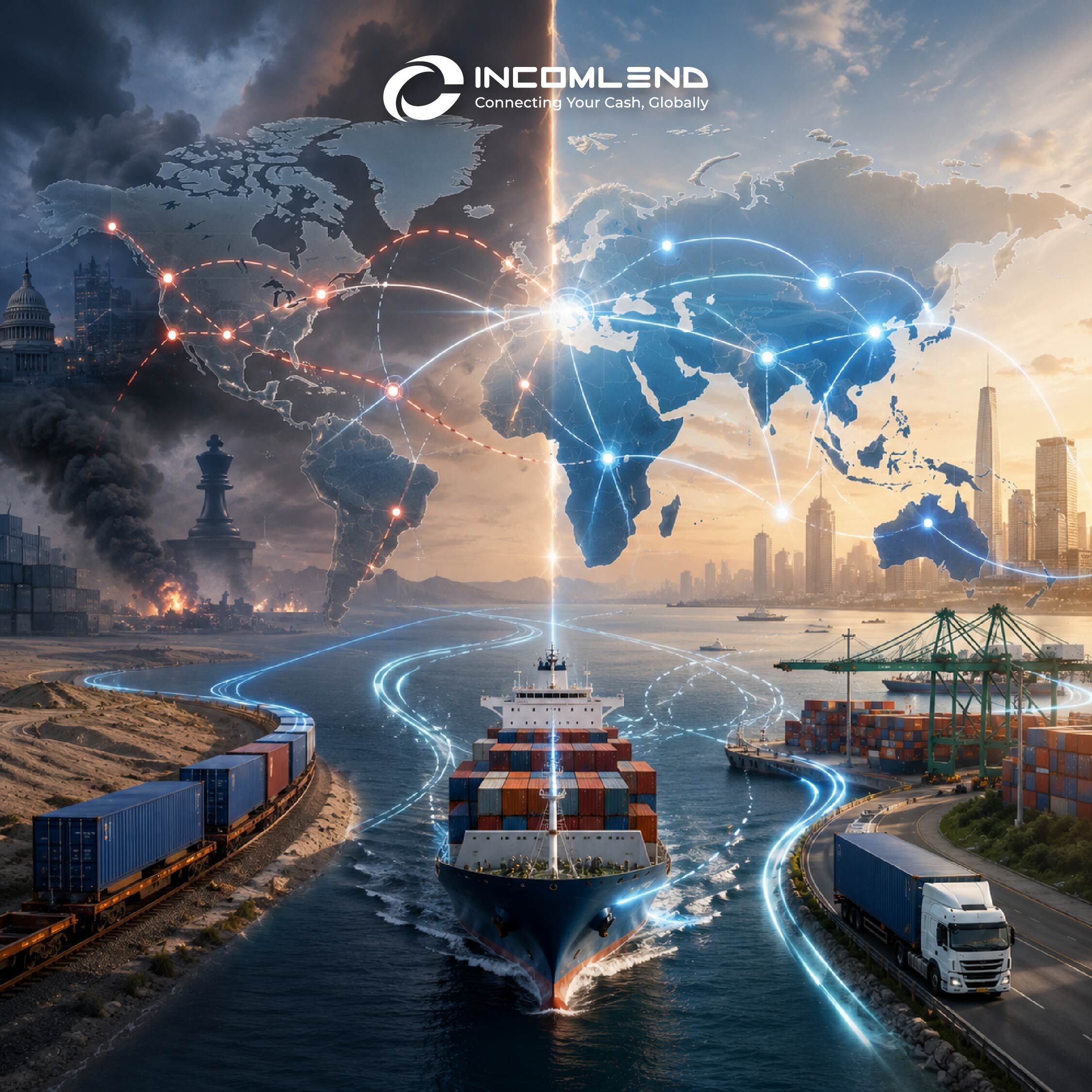
Global trade continues to grow despite tariffs, strategic rivalry and conflict around major transport routes. Goods trade reached approximately $13.7 trillion in the first half of 2026, up12.5% from the same period in 2025. Services trade increased by 10.5%. Together, goods and services added around $2 trillion to international trade during the period.
This expansion has taken place while US-China tensions disrupt established commercial relationships, conflicts around the Red Sea and the Strait of Hormuz affect shipping, and governments tighten controls over strategic technologies and commodities.
Such pressures have encouraged predictions that globalisation is collapsing. The data suggests a more complex transition.
Cross-border production remains close to historic highs. Businesses are redirecting suppliers, investment and cargo through different countries and corridors. Direct links between major rivals may weaken, but new connections are forming elsewhere.
Globalisation is entering a period of restructuring. Efficiency still matters, although resilience, political risk and access to finance now influence where goods are produced and how they reach customers.
Several recent indicators challenge the idea of a broad retreat from international trade.
The OECD reports that imported goods and services used in global production remained near their historical peak in 2024. Its analysis found that recent changes came mainly from shifts between sectors and sourcing locations, rather than widespread reshoring or shorter supply chains.
Foreign value added accounted for30.4% of OECD exports in 2022, the highest level recorded since 1995. Estimates for 2023 and 2024 indicate that international integration remained close tothis level.
The WTO reached a similar conclusion. Trade linked to global value chains represented approximately 46%of total exports in 2024. This was slightly below the 48% peak recorded in2022, but still close to historic highs.
More recent figures show continued expansion:
Higher commodity and transport prices contributed to some of the increase in trade value. Even so, indicators for container shipping, air freight and export orders continued to show growth.
These figures point toward persistent international interdependence. The composition and direction of trade are changing faster than its overall scale.
The clearest restructuring can be seen between the United States and China.
China’s share of US imports has declined since tariffs were introduced in 2018. During the same period, countries such as Mexico and Vietnam increased their share. This reallocation has developed through several channels:
Mexico illustrates how this trade reallocation works. Its proximity to the United States, existing industrial base, and access to the North American market make it a natural location for nearshoring.
Mexico became the United States' largest manufacturing partner in 2022 and its largest overall trading partner in 2023. The Federal Reserve Bank of Dallas estimates that trade diversion from China could eventually increase Mexican GDP by as much as 1%, provided that investment expands sufficiently.
Vietnam plays a similar role in Asia, although its relationship with Chinese production remains substantial. Research published by the Kiel Centre for Globalization in June 2026 identified two distinct developments:
The adjustment occurred in stages. Chinese suppliers diversified first. Local sourcing expanded later. US buyers changed their procurement patterns after those production links were established.
This distinction matters. Connector economies are doing more than redirecting finished goods. Many are developing new manufacturing capacity while continuing to import machinery, components, and intermediate products from China.
The result is a longer and less visible chain. A product may still contain Chinese inputs, even when the final exporter is located in Mexico, Vietnam or another third country.
Regionalisation has become another important feature of global trade.
Companies are reviewing supply chains through a regional lens, especially where distance, geopolitical alignment, or trade agreements influence risk. Several patterns are emerging:
These developments could appear to signal the formation of closed regional blocs. The underlying data shows significant links between them.
Several Central and Eastern European economies have increased their use of Asian inputs. Mexico has also become more dependent on Asian components while expanding exports to the United States. Regional production therefore remains connected to suppliers located much farther away.
In practice, many companies are using a combination of regional and global sourcing:
Companies are often adding suppliers rather than replacing one foreign source with a domestic alternative. This strategy creates redundancy and reduces exposure to one country. It also introduces more contracts, customs procedures, and financing requirements.
Trade between developing economies has grown into a major part of global commerce.
More than half of developing-country exports now go to other developing economies, according toUN Trade and Development. The Dubai Multi Commodities Centre estimates thatSouth-South trade represents about 35% of global trade, compared with approximately 25% for trade between developed economies.
This growth is creating stronger corridors between:
East Asia remains central to this expansion. UNCTAD found that South-South trade would have contracted during the first quarter of 2026 if East Asia had been excluded.
Policy is beginning to follow these commercial relationships. The São Paulo Round Protocol, a trade agreement between developing countries, moved closer to implementation in July 2026. Participating economies represent a market of about $18 trillion and more than four billion people. UNCTAD estimates that the agreement could produce welfare gains of up to $14 billion.
For businesses, the Global South increasingly represents a network of suppliers, processors, customers and logistics centers. Its role extends well beyond supplying raw materials to developed markets.
Geopolitical conflict has exposed the risks associated with major maritime chokepoints. Disruption around the Red Sea and the Strait of Hormuz has encouraged governments and logistics companies to develop alternative routes.
The Middle Corridor is one example. It connects China and Europe through Central Asia, the Caspian Sea, Azerbaijan, Georgia and Türkiye. Goods can reportedly travel from China to Europe in two to three weeks, compared with approximately six weeks by sea.
Interest has also returned to theIndia-Middle East-Europe Economic Corridor. The proposed system would combine ports, railways, energy infrastructure and digital connections between India, the Gulf and Europe.
Alternative routes provide flexibility, although their capacity remains limited. The WTO notes that around70 freight trains may be required to carry the same volume as one containership. New corridors therefore serve mainly as additional options and pressure valves.
Their expansion still has significant consequences. Countries that were previously located at the edge of major trade routes can become logistics, processing and distribution hubs. Infrastructure investment may then attract manufacturing, warehousing and financial services.
Globalisation is also changing at the sector level.
In early 2026, international trade increased by:
Demand for artificial intelligence infrastructure has supported trade in chips, servers, data centre equipment and electrical components. The electronic components index was the strongest element of the WTO’s June 2026 trade barometer.
Digital systems also help businesses manage more complex supply chains. Electronic documentation, automated customs procedures, real-time shipment data and AI-supported risk analysis make it easier to coordinate production across several jurisdictions.
Greater digital integration creates its own dependencies. Data rules, technical standards, cloud infrastructure and cybersecurity policies increasingly shape access to international markets. The geography of global trade now includes both physical corridors and digital connections.
Rerouted supply chains carry financial consequences.
Additional processing stages extend the time between purchasing inputs and receiving payment. Longer routes keep goods in transit for more days. Supplier diversification creates new deposits, contracts and minimum order requirements. Customs checks and rules of origin can delay delivery or payment.
These pressures increase the amount of working capital tied up in international trade.
Large companies may respond by holding more inventory or negotiating longer payment terms with suppliers. Smaller exporters often have less room to absorb these demands. Access to receivables finance and other forms of working capital can help viable suppliers participate in the new trade corridors without placing excessive pressure on their balance sheets.
Globalisation still connects producers, buyers and investors across borders. Its emerging structure contains more routes, more intermediaries and more deliberate risk management. Businesses that understand these connections will be better prepared for a trading system defined by constant adjustment.
Stay informed with expert tips, financial advice, and the latest updates to help you navigate your financial journey.